
From legacy systems to AI-powered software, we've got you covered.
We help mid-market companies make the right technology decisions and actually deliver on them — from modernizing legacy systems to production-ready AI.
Legacy System Challenges We Help You Solve
Modernizing legacy systems requires a neutral, total cost of ownership (TCO)-focused assessment. We start with a comprehensive discovery to understand your business and technical requirements—helping you evaluate options for sustaining or modernizing your current system, exploring off-the-shelf solutions, or implementing a hybrid approach.
Incomplete Picture of Your Technical Debt
Years of quick fixes, undocumented changes, and deferred upgrades leave codebases fragile, costly to maintain, and poorly understood. We assess code quality, surface hidden bottlenecks, and reconstruct system behaviour, even where documentation is absent or institutional knowledge has been lost, giving your leadership a clear, defensible baseline to act from.
Unclear Modernization Direction
Stabilize, optimize, rebuild, migrate to off-the-shelf, or a hybrid approach? Without a structured framework for evaluating options against business goals, risk tolerance, and total cost of ownership, decisions stall and momentum is lost. We replace guesswork with a clear, evidence-based recommendation your stakeholders can align behind.
No Clear Starting Point Across a Complex Portfolio
With multiple legacy applications in play, knowing where to begin, and how to sequence what comes next, is itself a significant challenge. We prioritize by business impact, technical risk, and system interdependencies, delivering a roadmap that builds momentum without disrupting operations.
Insufficient Stakeholder Alignment
IT sees the technical urgency. Finance sees the cost. Operations sees the disruption risk. Without shared understanding across leadership, modernization initiatives stall before they start. We facilitate structured discovery engagements that surface competing priorities, build consensus, and establish a foundation for confident decision-making.
Limited In-House Expertise and Incomplete Risk Visibility
Legacy modernization demands a specialized discipline most enterprises don't maintain internally, compounded by unclear exposure to end-of-life platforms, deprecated technologies, and deep vendor dependencies. We extend your team with architects and engineers who have led these programs at scale, and map your full risk profile before any commitments are made.
When Should You Consider Legacy Software Modernization?
If a legacy application is imposing specific limitations or hindering business progress, it could be time to evaluate the application. The six common areas to review are:
Robustness
Involves assessing your software's ability to function correctly and reliably even in the event of erroneous inputs, network issues, and other unexpected user interactions.
Security Compliance
Involves ensuring your software can withstand OWASP's Top 10 critical cybersecurity risks, confirming MFA use, checking for adherence to statutory regulations, and inspecting processes for creating and retaining audit logs.
Scalability
Involves analyzing how well your application adapts when data loads or user numbers increase to 2x or 3x capacity and considering what would happen if loads increased by even larger margins in the future.
Functionality
Involves evaluating how your application compares to functionality benchmarks for usability, internationalization, agility, tenancy and more.
Performance
Involves comparing your software's processing speeds and response times for typical front-end, back-end and database tasks to industry standards.
Technology
Evaluate how well your tech stack supports availability of resources, identify ties to outdated software, and ensure it's maintained according to industry best practices.
Factors to Consider When Modernizing
Ensure the justification for application modernization aligns with both business strategy and goals. If modernization isn’t essential for achieving current and future goals, resources may be stretched thin between competing priorities.
Highlight the benefits, such as improved operational efficiency, enhanced analysis capabilities, advanced technology integrations, cost reduction, and potential ROI from future revenue.
Commit to change management. Application modernization requires team alignment, with leaders championing the project, engaging as needed, fostering input from end users, and keeping communication open. To ensure lasting success, allocate an adequate budget for training and transition time for all users.
While modernizing legacy software is crucial due to competition and rapidly evolving technologies like AI, avoiding unnecessary spending in uncertain times can be a valid reason to delay modernization.
To move forward without straining your budget:
- Focus on the customer journey for optimization or rebuilding.
- Plan modernization for future growth and tech integrations.
- Understand supply chain technology requirements.
- Assess the approach and timeline for optimizing vs. rebuilding.
- Consider cloud-smart and data-smart strategies.
- Determine resource allocation for the project.
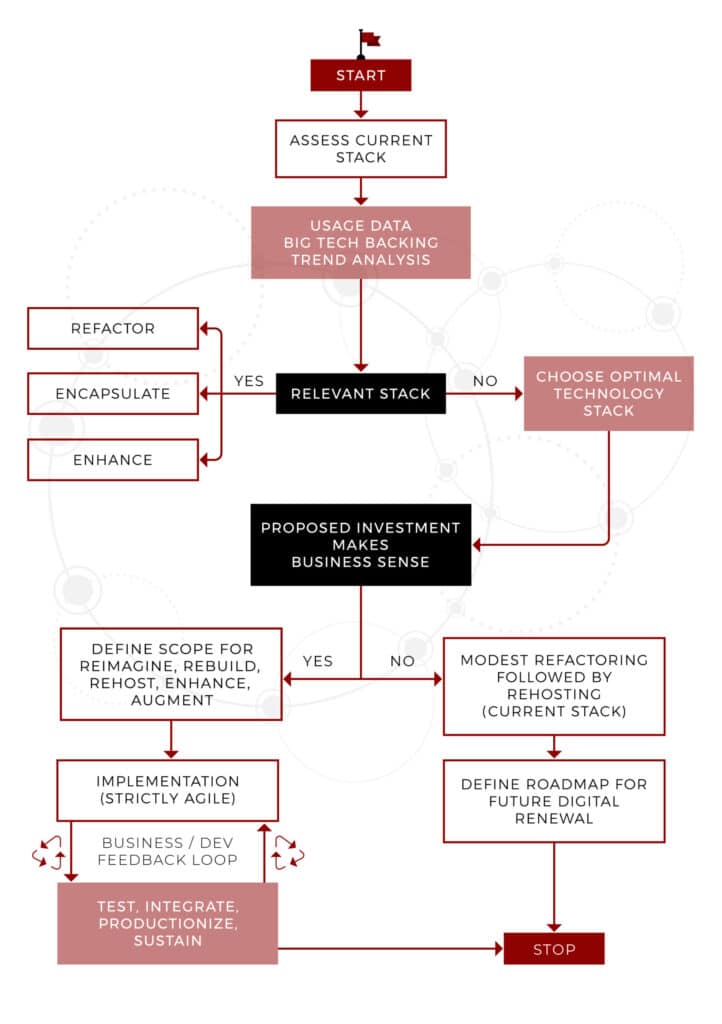
Only optimize if your application’s tech framework is supported and expected to remain viable for the next 5-10 years. If two or more of the following support indicators are missing, rebuilding in a modern, well-supported stack is likely a better option.
Key indicators of long-term support include:
- Assurance of backward compatibility in your current software/stack.
- Availability of local talent to work on your platform.
- Accessible community support (e.g., on Stack Overflow).
Less obvious indicators include:
- Use of your stack by major tech companies like Amazon, Apple, or Google.
- Frequent commits on GitHub (for open-source software).
Legacy Application Modernization Strategies
Wrap up legacy software in an isolated environment and manage access and communication with newer systems and technologies through APIs. This is often followed by a plan for a gradual phasing out of the legacy software by reducing access and putting phase-out timelines
Restructure and optimize the existing code (although not its external behaviour) to decrease technical debt and improve nonfunctional attributes.
Choose a modern technology stack that can keep up with your unique challenges and structure your application to handle growth and expanded functionality.
Experience unprecedented scalability and reliability by migrating your business-critical applications to the cloud.
Don’t let archaic software architecture slow you down. Whether you have a tiered monolith on your hands or an application that involves multiple microservices, we’ll make the best recommendations for your use cases.
Rebuilding is sometimes the most sensible way out of technical debt, and we can make it an affordable choice. Rebuilding involves rewriting and rearchitecting the application from scratch using modern technologies.
It’s always worth your while to get a second opinion before embarking on a major software project. We’ll examine your situation and provide unbiased options for your application modernization project.
If off-the-shelf software or SaaS offerings meet your requirements, we can help facilitate a comprehensive selection process. We’ll look at various things like technical and functional requirements, as well as external indicators such as market share, Gartner’s Magic Quadrant placement and adoption rate before we make our recommendations.
Benefits of Assessing Your Software's Performance
Now vs. Later
When you’re busy trying to make your month-end, assessing the state of your legacy software might not seem urgent or even important – especially if your system hasn’t failed yet or your team’s been able to engineer in-house workarounds to cope with day-to-day glitches. You might know it’s less than perfect, but with more pressing concerns, evaluating technical debt of your legacy software takes a backset.
But what if we told you that modernizing your legacy software could save you money, give you a leg up on your competition – whose systems are probably loaded with legacy software, as well – and allow your employees to spend more time innovating instead of struggling with software that’s seen better days?
Still not convinced? Consider these three additional benefits of legacy application modernization:
In 2023, the average cost of an enterprise data breach in Canada was a staggering $6.94M CDN (USD 5.13M), requiring an average of 322 days to identify and contain. Think your legacy software could stand up to an advanced cyberattack? Wonder if your company could cope with being locked out of key systems or data for almost a year?
Using legacy software to store sensitive customer data may already put your business at risk of violating privacy regulations, especially if operating internationally. Modern software is better equipped to adapt to evolving regulations and can provide an audit trail to prove compliance.
Could your company handle being locked out of key systems for nearly a year? Want to use IoT for warehouse monitoring, AI to cut product development costs, or expand your mobile app’s functionality? Without application modernization, these opportunities may not be possible.
Mantrax’s Approach to Providing Legacy Application Modernization Services
Unlike many other software modernization companies, Mantrax’s application modernization process goes well beyond software development. We work to discover and define what success looks like to you, make sure your project is set up correctly with a well-defined scope and a comprehensive statement of work, and then co-manage the critical path together with you to deliver your project on time and budget. The steps involved in realizing your legacy application modernization project include:
Discovery Call
An initial discussion with one of our seasoned Solution Architects to understand your requirements, the urgency of the problem, and long-term goals.
Assessment
We assess application functionality, the complexity, identify pain points and dependencies. The outcome is a high-level plan with modernization options, budget range, resources, timeline, and potential next steps.
Strategic Discovery
If there is a fit, then the first step is a strategic and in-depth discovery of the legacy application. Comprehensive functional and technical analysis, with a dep dive into its development history, current and future business objectives, supply chain dynamics, market trends, and input from all relevant stakeholders.
Modernization Roadmap
The output of the Strategic Discovery is a detailed modernization roadmap with solution architecture, technology stack recommendations, prioritized list of functionalities to be developed, detailed budget and timeline.
Statement of Work
Once you approve our recommendation, we create a detailed statement of work outlining prioritized requirements, solution design, tech stack, project plan, and key components.
Stay Ahead of Your Competition and Future-Proof Your Business by Embracing Application Modernization
Legacy application modernization helps businesses in key ways, including:
Although software modernization companies or consultants supplying application modernization services will each approach the process differently, it generally involves discovery, functional analysis and technical review phases that add inform refactoring, rearchitecting and reengineering tasks, and more.
While legacy software modernization can be challenging, with the right team working with you and for you, application modernization can drive digital transformations that are capable of creating incredible success for your company.
- Reducing programming and maintenance costs
- Boosting employee productivity by realizing efficiencies through streamlined processes
- Enabling scalability, mobility and integration with advanced technologies such as IoT and AI by migrating data and applications to the cloud
- Ensuring regulatory compliance, including by creating audit trails
- Introducing flexibility and agility that not only lets you easily customize features and add functionalities but future-proofs your business by keeping your systems from becoming obsolete